For the first time during my lifetime our world is living through something new to us. We’ve seen wars come and go. But there’s no playbook or set of instructions on how to handle a global pandemic. We are blazing a new trail while consulting with people whom supposedly are experts, and whom we hope are right. But what is lurking is an undercurrent of one thing we all understand—the fear of death.
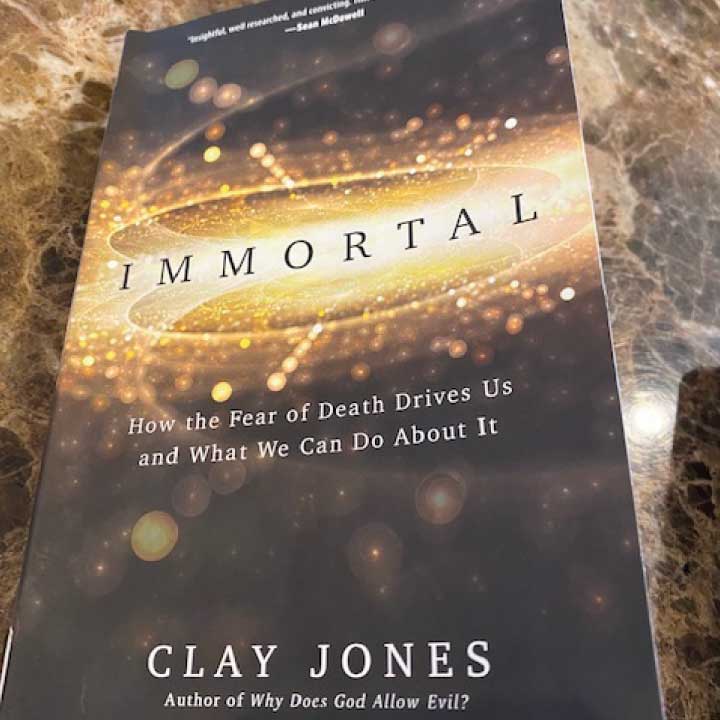
My friend, Clay Jones at https://www.clayjones.net/ just published his latest book—Immortal: How The Fear Of Death Drives Us and What We Can Do About It. You can find it on Amazon here. I was fortunate enough to get an early copy of it so I dove in.
As a professor for decades, and an expert on the problem of evil and death, Jones writes this book for the Christian audience. He understands human psychology, explores the different ways we face death, and how we use distractions in our lives to put off having to think about the inevitable. But he doesn’t leave us there with the stark realization of what makes us afraid of death. He offers us a way we can enjoy immorality, and what that will truly look like.
Jones writes that the thought of death forces us to think about the big picture—the important questions, and compels everyone to seek some kind of salvation.[1] He contends that we all have immortality projects—the strive to live forever, and adds that there are some who have gone to great lengths to achieve this either by some magic elixir as in ancient times, or by brain uploading (you’ll have to read the book for that explanation), cryogenics, or singularity—putting one’s trust in future technology (sounds like faith to me). He explains the problem with each of those views, and why immortality projects are evil.
But what does one do when he knows that literal immortality is impossible or unlikely? Strive to obtain symbolic immortality. Symbolic immortality projects are the gods of this age that humans seek to give them a kind of salvation without trusting in Jesus. Jones book Immortal is an apologetic work that demonstrates how the non-Christian’s secular salvation projects cannot save them. Jones demonstrates that symbolic immortality is the attempt to live on by accomplishing something on this earth of lasting worth by doing things like, “sacrificing ourselves to conquer an empire, build a temple, write a book, establish a family, accumulate a fortune, further progress or to create an information society and a global free market.”[2] This is what atheists do. Since they don’t believe in an after-life, they must figure out a way to leave a legacy of their existence. They can do this by starting a family, doing something heroic, being an activist or a celebrity, or even being a victim, as we see in our victimhood culture today. Even some Christians participate in some of these things to try to achieve some kind of symbolic immortality.
Atheists have their own means of dealing with death without God, and that is to make death not seem so bad. One of the ways they do this is to portray Heaven as boring and eternity as tedious. They picture themselves sitting on a cloud playing a harp for eternity in Heaven. But they are mischaracterizing Heaven. Jones points out that we have no reason to believe that the creator of all things would stop creating. Why shouldn’t we expect an amazing variety of foods, pleasures, and other infinitely amazing things?[3]
Jones continues that another method one may use to put off the inevitable is distractions—filling one’s life with amusement, or work. It’s the You-Only-Live -Once (YOLO) mentality. “Denial, however does little without distraction. After all, just telling yourself that you’re not going to die isn’t possible….we need to distract ourselves.”[4] We don’t want to think about the number of years we have left.
As I said earlier, Jones doesn’t leave us with the realization of our true selves. The Christian’s response to mortality enables the Christian to not only face death bravely, but to beat it. Jones offers evidence for the resurrection of Jesus, and explains that because of that resurrection, there is an afterlife in Heaven for Christians. To ease our fear, Jones provides solid arguments for the existence of God, for Jesus crucifixion and death, Jesus burial, the empty tomb, and finally the resurrection.
What happens to us when we die? Jones gives us a glimpse of Heaven by explaining what happens to our soul, what we will look like, what we will do there, and it’s far from boring!
Our faith is being purified right now my friends. We are not in control. We never were. This book will help clarify what is really at the heart of our fears. But remember, if you’re a Christian, there is nothing that anyone or anything can do to harm you. You are already seated with Christ. He lives in us, and us in Him (John 17: 21-23).
[1] Clay Jones, Immortal: How The Fear of Death Drives Us and What We and Do About It (Eugene, Oregon, Harvest House Publishers 2020) 21.
[2] Clay Jones, Immortal: How the Fear of Death Drives Us and What We Can Do About It, 57.
[3] Ibid. 102
[4] Ibid. 143