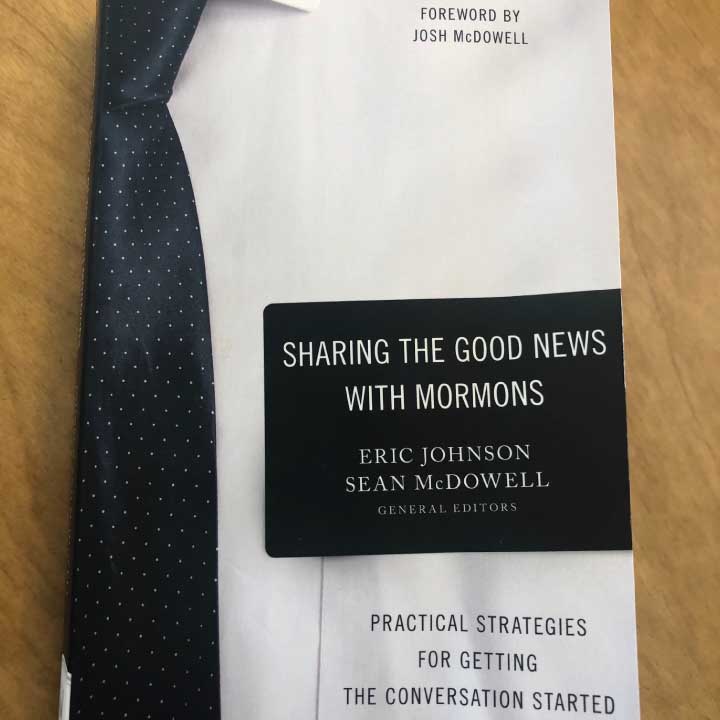
For sixteen years, John and I were neighbors and friends with the nicest Mormon family who lived across the street from us. We knew their beliefs were different than ours, and that they define Christian words differently than we do, but considering we hadn’t completed our Masters In Apologetics at that time, we felt that we didn’t know enough about their beliefs to know how to talk to them. Nor did we realize that there are many different approaches one can use when sharing the gospel with Mormons, and that we didn’t need a degree to do so. Two years ago they moved, and I felt defeated. This book is the book I wish I had read all those years ago.
Eric Johnson and Sean McDowell’s new book, Sharing the Good News With Mormons is, as the Harvest House Publisher, Terry Glaspey calls it, a “tactical toolbox” for any Christian who needs help in sharing the Gospel with any Mormon. Eric Johnson says it’s an “evangelistic smorgasbord,” because you can “nibble on some of the ideas and see if an approach fits your taste.” Since everyone has different personalities, and that means we all will have a different approach that works for us, and since most of us use at least one of these six approaches when trying to decide what to believe and why we should believe it, Johnson and McDowell have compiled tactics from various different authors who have shared the many different ways they have shared the Good News with Mormons in six different approaches. So you don’t necessarily have to read the book all the way through. Just read the chapters that appeal to your personality and communication skills.
The six different approaches are offered by authors such as Mark Mittelberg, Sean McDowell, Brett Kunkle, J Warner Wallace, Corey Miller and so many others. Many of the authors are either former Mormons, or they are experts in talking to Mormons.
One approach is the Basic Training Approach. This approach helps our Mormon friends evaluate truth claims, helps us share the Evidence Approach for the existence of God to encourage Mormons to examine the history of their faith. We can also use the Reliability of the Bible approach, or the Christ-Centered Approach where one discusses the real person of Jesus Christ.
There is the Reasoning Approach, which includes the Case-Making Approach where one looks at the evidence for Mormonism and causes one to ask, “Is there sufficient evidence for or against the claims of Mormonism?”
One of the most delicate situations in a family is when one member of a Mormon family leaves the “one true church.” When that happens, that person is no longer trusted, but shunned by the rest of the family and church members. If this has happened to you or someone you know, then pay close attention to chapter nine.
Countless times, I have respectfully turned away Mormons from my front door because I didn’t know what to say to them. Many don’t. I would say, “I am a Christian, and I appreciate what you’re doing but I’m not interested.” They graciously say, “Thank you,” and leave. Chapter ten focuses on what the Mormon at your door will say to you and how you should respond.
Did you know that responding to Mormon women requires an entirely different approach that includes transparency and vulnerability? Chapter eleven explains why.
Have you ever engaged with a Mormon on the internet? Perhaps in a Face Book group? Chapter twelve helps you to do so successfully.
There is no prior knowledge of the Mormon religion required to read this book. Although, the authors encourage the reader to do their homework on the religion to make one’s time with a Mormon more effective. The book is very reader friendly. In fact, at the end of this book, the authors have defined some Mormon terms to help the reader better understand the difference between the Mormon definition and a Christian Orthodox definition—there is a difference.
I found this book very helpful to my approach at my front door, or on the internet. I now have a better understanding of how Mormons think about those outside of their religion and feel better equipped to engage in conversation with them.
Johnson and McDowell highlight the most important points in this book. They are to be a good listener, and don’t try to do it all. No one can successfully employ every strategy in this book. But just try one. Just do something. God has given us all special gifts and it’s our responsibility to use them. Don’t listen to the lies of the evil one telling you that you can’t do it. Time and life are precious. Don’t waste them.