On September 15th, I published a blog post entitled Critical Race Theory—What is It, and How is it Influencing Christian Colleges and Universities? You can read it here. As a result of that blog post, I had several people ask me, “So which colleges are true to God’s Word? Which University can I trust?” So I decided that answering that question should be the topic of my next blog post.
I made phone calls to the very short list of colleges that I have been made aware of that are unwavering to Scripture. I had a list of questions that I asked each one. As a parent of two adult sons who are out of college and in their late twenties, I chose questions that I know I would want to know as a parent if I were sending my boys to college today, knowing what I know now. I am also a donor, so from a donor’s perspective, these same questions are equally important. These are questions that can, with the right answers, weed out any college that may be advocating for Critical Race Theory (CRT). Because there are many Christian colleges that are Christian in name only, this list is short. I just could not call them all. I did not get into asking questions about sports or other amenities that each college offers. This interview was solely about the college’s (for undergrads) commitment to Scripture, and their stance on teaching Critical Race Theory.
Here are the questions that I asked each college on my list:
- How is your Board of Trustees chosen? What is their theological education background?
- What is your vetting process in hiring faculty?
- Do you accept Federal Funding? If so, how does that play a part in vetting process in terms of hiring faculty and accepting new enrollees?
- Are you accredited, and if so, to what extent is your accreditation institution a factor in your hiring process, and the choosing of your curriculum?
- Who chooses your chapel speakers, and what is the vetting process in hiring that person?
- Do you read the doctoral dissertation of prospective faculty members and administrative staff (i.e…the provost) before hiring? If you read the blog post I published on September 15, 2020, you will understand why I am asking this question.
- What is your school’s position on Critical Race Theory and the Black Lives Matter movement? Is it advocated for on campus in any way such as in chapels, or student conferences?
During my research for this blog, I called about a dozen colleges. What follows is the response I received from those who responded to my calls. I spoke to either the college president personally, or his representative. As a donor, these are the kinds of colleges that I would seriously consider supporting. Their models reflect high Biblical standards in their teaching, and in their expectations of their students. Their presidents are leaders who are steadfast in their walk with Christ, and their commitment to the Kingdom. If you have a heart for Christian higher education, consider these three. Each of these has something unique about them, which I have indicated in italics.
Arizona Christian University (ACU)
Located in Glendale, Arizona, ACU’s mission is to provide a biblically-integrated, liberal arts education equipping graduates to serve the Lord Jesus Christ in all aspects of life, as leaders of influence and excellence. You can view their about page here.
My contact there was with President Len Munsil, who is a true leader. He was named Leader of the Year for 2020 in the area of education for ACU’s contribution to the local community and the state of Arizona. You can read about that here. His track record is very impressive. He is a husband, and father of eight children, a journalist, an attorney and an author. He ran the Focus on the Family group in Arizona for ten years, attended law school, is a defender of life, and a Reagan era ASU graduate. He hired his friend George Barna, founder of the Barna Research Group to be the director of his Cultural Research Center. ACU is the first Christian university for which The Barna group has developed a survey that the students will take when they come in and when they graduate, indicating their worldview when they enter, and how much it has changed upon graduation. This is a very unique, yet common sense way to measure success. They just conducted their first surveys this last August. Because of this model, now there are Christian elementary schools who want to follow suit, and survey their students too. My biography of him here doesn’t even do him justice. It would be better if you just read his bio for yourself here. Munsil’s wife Tracy leads the Cultural Research Center at ACU. She is also a lawyer, and started the Political Science dept. at ACU. This married couple is a pair of movers and shakers.
Arizona Christian University has approximately one thousand students. Eight hundred currently on campus, and two hundred on line. They have had some transfers into their university from other universities out-of-state who’s campuses are not currently open. They meet in eleven different classrooms, all social-distance ready.
Their chapels are in their auditorium, and currently they are at half capacity for Covid19 safety reasons. They do bring in outside speakers for their chapels. Some have been well-known. Two examples are the late Herman Cain who spoke some time ago, and the Governor of Arizona. During Black History month, he brought in a black conservative council to speak on black history from a Biblical perspective.
Arizona Christian received, for 4 straight years now, its first-ever national rankings as a Best College by U.S. News & World Report — including this year being ranked as the No. 1 Best College in the West region for Undergraduate Teaching.
- Their Board of Trustees gets extensively queried about their core commitments to Scripture. Their by-laws require 2 pastors on the board. They have two now, and will have a third soon.
- All faculty are vetted through department heads first, then the provost, then Dr. Munsil. Vetting is extensive to make sure that the school remains culturally, and theologically conservative. There was a math teacher who started teaching and advocating for socialism in the classroom. He was fired immediately. There is a no-tolerance level for any kind of Critical Race Theory or Black Lives Matter movement being taught on his campus. That is refreshing!
- During my conversation with Dr. Munsil, he said that ACU does accept Federal Funding and he explained why. He said that he used to want to be free of that. But now he thinks that if federal funds were not available, it would hinder students who want to get a Christian education from a reputable university from doing so because they would go to a secular university instead. He also added that accepting federal funds has not hindered his ability to speak out on ACU’s principals at all.
- Munsil’s accreditation organization is the Higher Learning Commission out of Chicago. He has not been hindered by them in any way in terms of who he hires or their curriculum choice. He said that the mission of ACU is to educate Christians. If he doesn’t do that, he is violating his accreditation.
- Chapels are required twice a week, and the vetting process for the person who gets their chapel speakers is the same as it is for hiring other faculty and staff.
- ACU does not read the entire doctoral dissertations during hiring. However, faculty go through extreme vetting.
- Dr. Munsil would not tolerate any teaching or promotion of Critical Race Theory or Black Lives Matter at any time on his campus.
It was a pleasure talking to Dr. Munsil. His final words to me were that, “A lot of Christian colleges don’t understand the battle we’re in….this is about the Kingdom.” That’s why every student that graduates, will graduate with a minor in Bible.
College of the Ozarks
College of the Ozarks (C of O) has fifteen hundred students, and is located in Point Lookout, Missouri, just outside of Branson. Dr. Jerry C. Davis is president of College of the Ozarks. Davis assumed the presidency in 1988, after having served as president of Alice Lloyd College in Pippa Passes, Kentucky, for eleven years. His tenure of 43 years in the college presidency is among the longest in the United States. Dr. Davis received his doctorate in 1970 in Biological Sciences from Ohio State University; he earned his master’s degree at the University of Tennessee and bachelor’s at Mars Hill College.
Davis and his wife of almost 54 years live in Hartwell, Georgia, which is a small town in the foothills of northern Georgia. When he was in high school, he attended Mt. Berry School for Boys in Georgia—a boarding work high school. President Davis considers it a special calling to lead College of the Ozarks. He has modeled C of O after Berry, saying, “Having been profoundly influenced by a work school gives me a special appreciation for this college. It is a uniquely American institution, providing opportunities to deserving young people willing to work for a higher education and better way of life.” Since 1988 the institution headed by Davis, called Hard Work U. by The Wall Street Journal, has received national acclaim. Its self-help work program was strengthened and a no-tuition policy maintained. More importantly, the endowment has grown to over $500 million dollars, making the College one of America’s strongest.
Under Dr. Davis’ leadership, College of the Ozarks has been repeatedly named by annual U.S. News & World Report surveys as one of the nation’s best. It has also been recognized by Money Magazine, Forbes, New York Times, The Wall Street Journal, Peterson’s Guide, Barron’s Best Buys in College Education and other publications. The College has been featured in USA Today, The New York Times, and The Wall Street Journal. The character of the school has been cited by the Templeton Foundation Honor Roll for Character Building Colleges and Free Enterprise. The College has been featured repeatedly on FOX News Network, CBS, ABC, and various national radio networks. And, the College has been named a Great College to Work For by The Chronicle of Higher Education many times.
When I contacted C of O, Dr. Davis was trying to meet a book deadline. So I spoke to his VP of Academic Affairs, Eric Bolger, who was more than willing to answer all of my questions.
- Board members are chosen by a nominating committee for choosing additional members. Much of their board is comprised of alumni, who are all very familiar with the college’s mission, which was established in 1906. Their board is highly engaged with mission and finances in mind. Their accreditation institution visited and commented on how well versed they are in the mission of the college.
- Faculty are hired by Eric. Since C of O advertises itself as a distinctively Christian college, he makes it clear that applicants are expected to teach from a Biblical perspective. Eric asks them to tell him how they integrate God into their curriculum. Each prospective faculty member must respond in writing to a series of statements, including questions about their Christian faith. Each faculty member must also have a church relationship, and articulate their position with Christ. Then they meet with two other administrators. There’s something unique about their faculty; all faculty have to go through a rigorous committee review every six years. No one gets tenured. Each faculty member is given books to read, and then they must present their thoughts to a panel.
- C of O receives Title Four funds for low income students. They are grants only. This is what is unique about C of O. They are a work college. Their constituents are students who can’t afford a formal college education. So, each student works on campus for 15 hours per week in turn for free tuition. Donors make up the difference. This means that each student graduates debt-free. Because of this, C of O can be highly selective. Needless to say, they have very high behavioral expectations of their students. They look for Christ-like character, hard-working, and patriotic students. They only accept 8-10% of those who apply.
- C of O is accredited by two institutions—The Higher Learning Commission, which is a regional accreditor, and by the Trans National Association of Christian Colleges and Schools (TRACS). Each institution makes sure that their colleges are teaching a certain number of hours, and that they’re teaching what they say they are teaching.
- Vetting of chapel speakers is also done by Eric. Their chapels are on Sunday mornings and the speaker is their Vice President for Christian Ministries. In addition to chapels, they also have convocations once a week. To choose their convocation speakers, they have five Vice Presidents each of whom focuses on one of five areas of character development: cultural, academic, vocational, Christian, and patriotic. They have had very well-known speakers such as President George W. Bush, Governor Sarah Palin, former Speaker of the House Newt Gingrich, former Prime Minister of Great Britain Margaret Thatcher, Benjamin Netanyahu, and Ben Carson. They consistently have speakers who come from a conservative view point. The list is even longer than that. You can read about more of their speakers here.
- Doctoral dissertations are typically not read upon hiring because most administrative staff are working on their doctorate while they work at C of O. Even though the dissertations are not read, they are discussed, so that the administration gets to know, and can vet the prospective faculty member in a more personal way.
- C of O has a no tolerance policy for any teaching or advocating for Critical Race Theory or Black Lives Matter ideology on campus. Eric said that if either of those things were advocated for by anyone on campus, that person would not remain employed at C of O. They are extremely careful in who they hire.
As I stated above, College of the Ozarks has earned many accolades. Visit their home page here.
Hillsdale College
Drawing from fourteen countries, and fifty states, Hillsdale College in Hillsdale, Michigan, is a conservative Christian university that currently has about 1450 undergraduate students. It is truly a national, and international liberal arts college. Right now, their campus is open, and most classes are in person, although a handful operate virtually.
I had the honor of communicating directly with President Larry Arnn. Arnn is the twelfth president of Hillsdale College, and he brings a wealth of knowledge in government, economics, and modern history to Hillsdale. He has an M.A. and a Ph.D in Government. He studied International History in London, and then Modern History at Oxford. After returning to the United States, he served as president of the Claremont Institute, in Southern California. While there, he founded the California Civil Rights Initiative, which was passed by California voters in 1996, and prohibited racial preferences in state hiring, contracting, and admissions.
Dr. Arnn has served on several board, has received the Department of the Army’s “Outstanding Civilian Service Medal,” is a member of several societies, and has been published widely in national newspapers, magazines, and periodicals on issues of public policy. He is also the author of three books.
In addition to serving as president, Dr. Arnn is a professor of politics and history at Hillsdale, teaching courses on Aristotle, Winston Churchill, and the American Constitution. Dr. Arnn and his wife Penelope, have four children.
There are three things that make Hillsdale different than the vast majority of schools.
First, They have a classical liberal arts core curriculum, focused on the greatest ideas, and discoveries of Western Civilization. The Core is massive, and includes courses from the Humanities, the Social Sciences, and the Natural Sciences. All students must take these courses, which amounts to about half of their time at Hillsdale. The Second thing is that Hillsdale operates completely independent of all government funding from both federal and state levels. This is a principled stance they take in order to provide an education that they believe best serves Hillsdale’s mission, which is to develop the minds and improve the hearts of their students. The third thing is the Hillsdale Honor Code, which states that “A Hillsdale College student is honorable in conduct, honest in word and deed, dutiful in study and service, and respectful of the rights of others. Through education, the student rises to self-government.” A focus on cultivating self-governance in our students is important, and this Honor Code helps to build a campus culture akin to the pursuit of these virtues.
Here are Dr. Arnn’s answers to my questions:
- The board consists of thirty-five trustees who hold five-year terms. All vacancies are filled by the majority vote of the trustees present at voting.
- The College is a partnership, a community of learning, and our hiring process reflects that. After the College advertises open faculty positions for departments, each department then considers the applicants, some of whom are invited to visit campus and undergo several rounds of interviews by faculty, teach a sample class, dine with students and others of the College community, and meet with the Provost and myself. The final selection is a holistic one, based on the input of all involved in the process.
- We are accredited by the Higher Learning Commission and have been since 1915. The commission does not dictate curriculum or individual hires but imposes reasonable policies about faculty qualifications.
- The College stopped receiving federal funding in the 1980s, when the government asked us to begin tallying students by ethnicity. We are, therefore, free from demographic quotas and requirements on the curriculum. You may find further details here.
- Faculty and staff collaborate to select speakers for College events. The selection of speakers is based on their prior interactions with faculty and staff, their demonstration of knowledge in a relevant field, and esteem for the principles the College upholds.
- Students as well as faculty and staff are required to sign the Honor Code, found here, which means they agree to cooperate with and support the mission and cause of the College. No one is required to believe or not believe anything but only to promise to act and speak virtuously and work hard in pursuit of learning.
- Our only required religion class is Western Theological Tradition. However, the great Christian texts and portions of the Bible are read widely and deeply in other courses—Western Heritage and Western Philosophical Tradition, for example.
Last, you can read Hillsdale’s Founding Documents and Resolutions, found here. Hillsdale College is one of the few places left that still regards its founding as sacred and forever instructive. Their website found here, can give you more information about student life, Hillsdale’s core, and anything else you may want to know about Hillsdale College.
New St. Andrews College
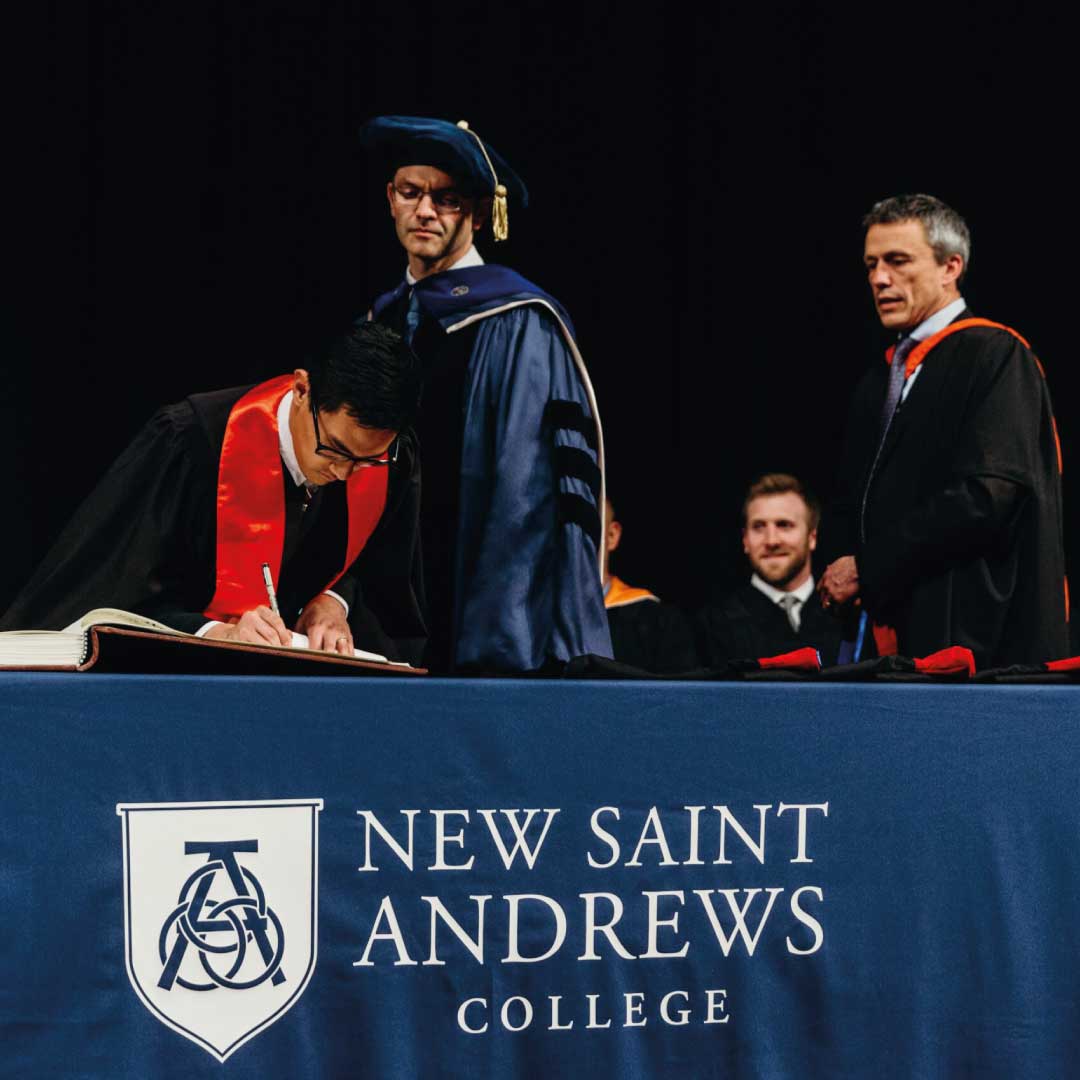
When I first called New St. Andrews College (NSA) located in Moscow, Idaho, and I asked for the president’s office, the voice at the other end said, “This is the president.” That said something about his humility right there. How many college presidents do you know who would answer the phone themselves? I was talking to Ben Merkle, who has been NSA’s president for five years now. Our conversation was a delight, and it didn’t take long for me to figure out what makes NSA so special. NSA offers a Classical Liberal Arts education to their students. A classical education teaches students to become leaders, to think critically, and be able to analyze facts, which means that one is not just learning facts, but skills. Merkle’s wife Rebekah contends,
“A classical education teaches one to be an articulate, clear-thinking, creative, and persuasive leader, which doesn’t just shape your education, but your personality. Students will learn the Seven Liberal Arts—Grammar, Logic, Rhetoric, Math, Geometry, Music, and Astronomy.” [1]
They will do all of that, while learning about God’s role in each.
New Saint Andrews College is a very unique and special place. As a college, it was born out of a need to continue classical education after K-12. The goal is to build on the foundation these kids received and continue to push them at the college level. NSA currently has 200 students, but the phone is ringing off the hook with new applicants. They have one hundred so far, who are applying for the next semester. Graduates of NSA will graduate with one distinct Bachelor of Arts degree—Liberal Arts. All final exams are oral and given on a one-on-one basis with the professor.
I watched a video on You Tube with Steve Turley when he interviewed President Merkle. You can watch it here. In the video, Merkle defines classical education, and how it differs from a regular, public/secular college education. He contends,
“In the last 60 years, our definition of education has been radially reshaped. If you ask someone why they go to college, everyone will tell you that it’s about getting a job. What you don’t realize, is that when you take that mindset, you turn yourself into a cog in a machine. You believe that your job is to get a job. It’s like the world is this coming machine, and it’s your parents’ job to craft you into the perfect gear, so that when they offer you up to the machine, the machine will accept you, and you can hum in your little place in the machine. If they do a bad job, and you get a degree in some useless major that doesn’t get you a job, then when they offer you to the machine, the machine will shoot you out because that’s not an employable skill. That’s every parent’s fear—that the job will not be acceptable by the machine. But that is not what an education is supposed to be for. It should be for the cultivation of your soul. Ultimately, our job is to be worshipers of God. Ephesians 5 commands us, and the Westminster Catechism demands this. At NSA, we are training children to be worshipers of God with all of their life. So we are teaching them to think of the world in terms of their service to God. That’s going to include family, church and your job. Jesus says that if you seek the kingdom first, that all will be added to you. So if you make your education about serving God, He tells you that all these things will be added unto you. So NSA educates the whole man, and now they have someone who is very highly employable. NSA gives the student the apparatus to be thinkers and doers. They’re entrepreneurs, film makers, writers, lawyers, pastors, teachers, business owners, and they’ve figured out how they can offer their skills up to the service of God…the ultimate goal has to be the worship of the triune God. From that will flow the ability of a family, and a cultivation of a career.”
Interesting Facts about NSA:
NSA tracks the divorce rate of their graduates. Fifteen years after college, they have a less than 2% divorce rate. That is impressive.
NSA is so focused on culture shaping, that its elders have written a book, titled, 30 Theses On Culture Shaping, where the theses are a combination of what will be given to the students, and what will be required.
Merkle’s wife Rebekah is the daughter of Douglas Wilson, who was inspired by Dorothy Sayers who wrote, The Lost Tools of Learning, in which she laments the loss of the older methods of education. Wilson put her ideas into practice and started classical education. He also authored the book, The Case for Classical Education.
Here are Merkle’s answers to my questions.
- Our board is a blend of ministers, classical Christian educators, and businessmen. They are all required to be members of evangelical churches and must subscribe to our statement of faith. The board self-replicates. So they fill openings themselves. However, the board is broken into three different positions. Position 1 members (6 out of 13) are permanent appointments. They can only be chosen from a pool that has been created and approved by Christ Church, the local church that originally started the school. The church also has ongoing input into the vision of the school. But the creation of that pool of candidates is their primary means of influencing the school. The other two positions are four year appointments and are selected by the board themselves. The main difference between position 2 and 3 is that position 3 members must live a certain distance from here in order to keep a distant perspective as a part of our conversation.
- We have a pretty rigorous statement of faith to which they must agree. All potential hires travel out, teach a class for us to observe, and spend time with both the academic dean and myself. I usually want them to bring their family because I know a lot about someone when I meet their spouse. So my wife and I take them to dinner and spend time with them. All theology teachers require additional vetting and approval from the board.
- We take no federal money. Tuition is funded by the sponsoring church, and donors.
- We are accredited by TRACS, a Christian accreditation agency. And we are currently pursuing NWCCU, a former regional accreditation agency. Accreditation requires that we be able to show a certain level academic qualification for our faculty hires. They have not restricted us with regard to statement of faith requirements. I have been pretty direct with NWCCU about our faith requirements and so far that has not been a problem for them.
- We don’t have a weekly chapel service because we tell the students that we are not their church and don’t want to replace the role of the church in their life. All students are required to be attending a local evangelical church. There are a number of options and we don’t say which one they have to go to. We do have a weekly meeting called Disputatio. It is more of an academic meeting. We have debates, guest speakers, student presentations. Because we like lively debate, we make no promises about the orthodoxy of the speakers. Sometimes we have atheists or communists or who knows what.
- I have to admit that I have not done that (read prospective faculty’s doctoral dissertations). But now that you say it, that seems like a really obvious and important step in the hiring process.
- This video that NSA produced about BLM says it all. There’s no chance that NSA would ever advocate for BLM or Critical Race Theory. Watch this powerful video.
For more on President Merkle, view his President’s Page. For more about New Saint Andrews College, view their Home page here, and their Statement of Faith here.
I learned a lot about Christian colleges in my research for this blog. Each one offers something unique. I hope this answers some questions for those of you who asked me, “Where can I send my child? Where are the solid Christian schools?” If you have a heart for Christian higher education as a donor, then consider these three. If I had to do it again, I would send my boys to any one of these schools.
[1] Rebekah Merkle, Classical Me Classical Thee: Squander Not Thine Education, (Moscow Idaho, Canon Press, 2017).